
The new EU-India axis
Why the EU-India Free Trade Agreement matters for the energy transition

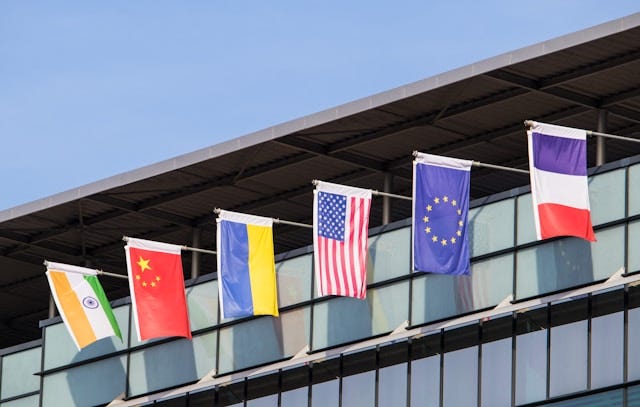
While the Iran War is by far the dominant story in 2026 geopolitics, a major event that happened earlier this year and might have long lasting impact on global affairs for decades to come, is easily overlooked.
I am, of course, talking about the EU-India Free Trade Agreement. We cannot underestimate the importance of this agreement. If the EU would be considered a single country its economy would be the second largest, after the United States, pushing China to third place (currently hold by Germany).
India, meanwhile is at the present moment the fifth largest economy. And India is steadily growing, albeit it not as fast as China used to do. Personally I believe that due to the structural problems with the Chinese economy, India will eventually surpass China somewhere this century.
Also, as emphasized by the Kiel Institute’s analysis of the EU-India FTA, both the EU and India are the major democratic blocks. This is important as the European Union seeks to diversify its trade dependencies away from both the United States and China.
This Free Trade Agreement is a large treaty, so I want to focus here on the following:
Tariff reductions
Removing technical barriers to trade
IP protections
Agreement on green transition
The first two points will stimulate trade with India and the European Union and will hence increase demand for shipping. In the short run more shipping will mean a greater demand for oil. An important caveat here, is that the FTA will take years to ratify and implement. Also success is not guaranteed in this increasingly volatile world.
The protection of intellectual property and the green transition are intimately linked together, as the latter need the former. No innovation in energy technology will be worth investing in without a solid legal framework.
The energy transition is very important for India as the country is heavily depended on oil from the Gulf. The recent full electrification of the Indian Railways is a major step in reducing its dependency on fossil fuels, but the country has yet a long way to go.
While both the EU and even more so China have booming markets for electric cars, EV sales are low in India. Long standing rivalry with China has made India weary of more dependency on Chinese electric cars.
India and the European Union have strong complementary interests in the energy transition.
For starters India has the largest reserves of thorium in the world. Thorium is the fuel for safe and proliferation free nuclear energy, especially in the form of Liquid Fluoride Thorium Reactors (LFTRs). LFTR should be the bedrock of the nuclear strategies of both the EU and India.
India’s thorium reserves are mostly in the form of monazite sand. Very importantly monazite is extremely rich in Rare Earth Elements, the very stuff now primarily controlled by China. Rare Earth Elements are essential for the permanent magnets used both in electric motors and wind turbines.
EU-India cooperation on the development of LFTR technology will kill two birds with one rock. In theory India could eventually replace China as the main supplier of refined Rare Earth Elements. And this will neatly fit into the EU’s own policy of diversifying its supply of critical minerals.
The export of refined Rare Earths Elements and permanent magnets would without a doubt be a major boost to the Indian economy and the FTA with the EU will provide easy access to an obvious market.
On the other hand the European Union could become a major supplier of lithium. A recent studies show that geothermal brine could be a great source of lithium. In particular the North German Basin appears to hold significant reserves.
If lithium extraction from geothermal brine will materialize this will give a boost to the European EV battery sector. And the EU-India FTA will create easy access to a potentially large market.
Put together thorium and Rare Earth Elements from Indian monazite and lithium from European brine will provide solid base for the energy transition in both blocks. LFTRs will provide clean and affordable power to nearly a third of the world population, while European lithium and Indian Rare Earths will allow the accelerated adoption of electric vehicles.
Another area where EU-India cooperation will be mutually beneficial would be to development of e-fuels. These are synthetic hydrocarbons that made from water and captured carbon dioxide. Electricity is used to convert these into a variety of fuels that can be subsequently used in convention combustion engines.
E-fuels are a critical part of the energy transition, since they do not affect consumer behavior and are hence likely to create public resistance. Replacing existing internal combustion cars with electric one will take years and are subject to supply constraints on critical minerals.
Electrification of aviation is even more of a long shot and e-fuels, in the form of sustainable aviation fuel or e-SAF, are at the present moment our best bet for sustainable aircraft.
The production of e-fuels requires a reliable source of clean energy, which could be provided by LFTRs.
The EU-India Free Trade Agreement is a first and positive step toward a stronger relation between these two democratic economic powers. The EU and India both need each other to successfully pursue the energy transition. Utilizing the thorium fuel cycle should be at the heart of this.